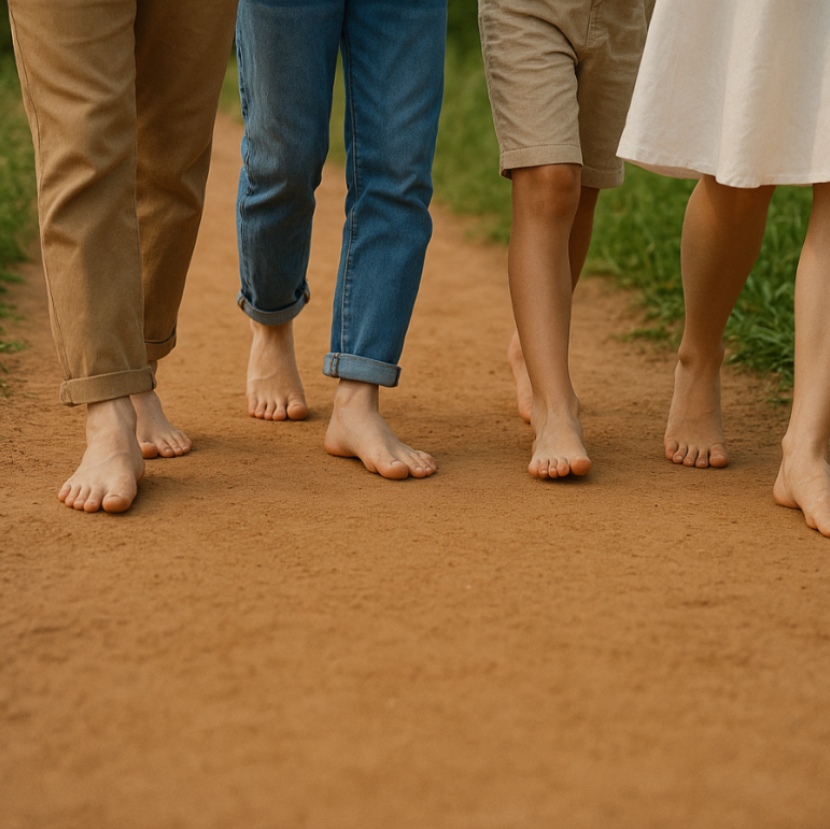
Why Koreans Walk Barefoot in the Park: The Magic of Earthing
Barefoot walking in Korea has become a popular health trend in local parks and mountains. Have you ever wondered why so many people are walking on the soil without shoes?

What is Earthing?
- Principle: It is based on the idea that by connecting (grounding) the body to the earth, you can eliminate active oxygen in the body by neutralizing the difference between the micro-currents in our body and the earth’s negative charge.
- Benefits: There are opinions that it can help alleviate autoimmune diseases such as rheumatoid arthritis.
How to Practice Safely
- You don’t necessarily have to walk a lot; simply making contact with the earth, such as walking in place barefoot, can be effective.
- “Super grounding,” which involves standing on moist sand at the beach, is also recommended.
- Since the foot is composed of numerous bones and joints, stimulating them is generally good, but it is important to practice within your limits without overdoing it.
⚠️ Important Precautions
Before you start, please keep these three things in mind:
Tetanus Prevention: There is a risk of injury, so it is highly recommended to get a tetanus vaccination (once every 10 years).
Caution for Diabetics: It is best to be extremely careful or avoid it altogether, as there is a risk of diabetic foot complications, which could lead to more harm than good.
Joint Protection: Avoid excessive walking and be sure to maintain proper form so you don’t put undue stress on your joints.
계족산 황톳길
Key Highlights: 14.5km of Healing
- The Highlight: This location boasts an incredible 14.5km long red-clay path, the longest of its kind in Korea, offering an unparalleled experience for barefoot walking enthusiasts.
- Why it’s special: The vast scale of the 14.5km track, combined with the shaded deck path, provides a perfect environment for health-conscious visitors and nature lovers to enjoy “Earthing” comfortably.
- Gyejoksan Mountain Red Clay TrailSan 86-1, Jang-dong, Daedeok-gu, Daejeon, Republic of Korea

Unique Attraction: This location is gaining attention as a premier destination for “Earthing” (walking barefoot), featuring an extensive shaded deck path.
Travel & Wellness: It has become a popular spot for both travel enthusiasts and those interested in senior health, providing a unique environment for barefoot walking.

Tip:
- No matter where you are in the world, there’s bound to be a patch of earth nearby perfect for a stroll—a mountain, a field, or even a local playground will do.
- Before you head out, just remember to pack a pair of sandals and bring a small towel and some water to wash your feet afterward. You’ll be glad you did
- If winter weather—like bitter cold, rain, or snow—keeps you confined to the city, don’t worry. You can still bring the healing power of the Earth indoors by getting some soil and creating your own little grounding space at home.

Koreans believe that connecting our feet directly to the earth helps us release stress and improves our health. It’s a simple, free way to find peace in our busy lives. Next time you’re in Korea, why not take off your shoes and feel the earth beneath your feet? You might just find your own little moment of healing.
🗣️ Quick Korean Lesson: How to Say “Barefoot Walking” Like a Local
Since you now know why we do it, let’s learn how to actually say it in Korean!
The word for barefoot walking is 맨발 걷기.
- How it looks: 맨발 걷기
- How to pronounce it: Maen-bal Geot-gi
Here is a friendly breakdown to help you nail the pronunciation without sounding like a textbook:
- 맨발 (Maen-bal) = Barefoot
- 맨 (Maen): Pronounce it just like the English word “man.” Easy, right?
- 발 (bal): Careful here! It’s not a heavy English “ball.” Try to make the “b” sound softer, almost halfway between a ‘B’ and a ‘P’. Keep your tongue light on the roof of your mouth for the ‘L’ sound.
- 걷기 (Geot-gi) = Walking
- 걷 (Geot): This is where most learners get stuck. The “G” is very soft, and the vowel sound is like the “u” in “cut” or “hut.” The batchim (bottom consonant ‘ㄷ’) means you stop the sound sharply at the end. Don’t let the ‘T’ sound escape!
- 기 (gi): Just a clean, simple “gee” (like in geese).
💡 Bonus Word for Adventurous Travelers!
If you visit Gyejoksan Mountain Red Clay Trail in Daejeon (the famous trail mentioned above), you’ll walk on a 황톳길 (Red Clay Path).
- Pronunciation: Hwang-tot-gil
- Speaking Tip: When saying 길 (gil), keep the “g” soft and the “ee” sound short. It sounds closer to the English name “Gill” than “Geel.”
Next time you see someone earthing in Korea, you can confidently smile and say, “Ah, Maen-bal Geot-gi!” They will be absolutely thrilled to hear your perfect pronunciation!