Study in Korea Cost Simulation
⚠️ Disclaimer: This article is for general informational purposes only. Please confirm exact amounts directly with your school, the National Health Insurance Service (NHIS), and airlines.
한국 유학 1년 비용을 학비, 생활비, 보험, 항공권으로 나눠서 시뮬레이션해보면, 국립대 기준 약 1,400만~1,600만 원, 사립대 기준 약 2,200만~2,600만 원 정도가 나와요. 도시·학교·생활패턴에 따라 ±30% 이상 차이가 날 수 있어요.
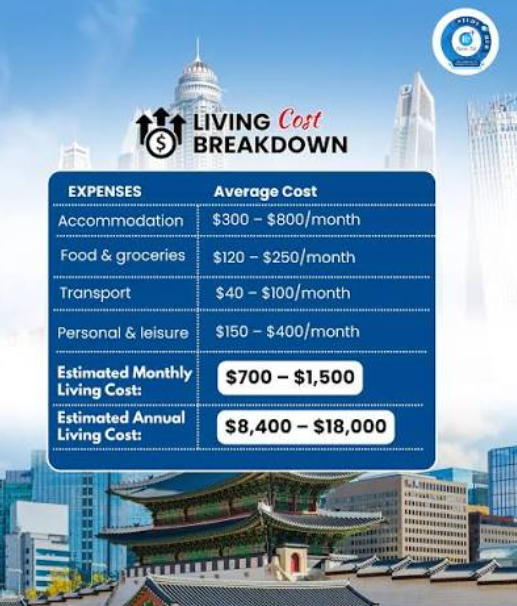
Simulating one year of studying in Korea by splitting costs into tuition, living expenses, insurance, and flights comes out to roughly 14–16 million KRW for national universities and 22–26 million KRW for private universities. This can vary by ±30% or more depending on the city, school, and lifestyle.
1. The Four Pillars of Study Abroad Costs
유학 비용은 크게 학비, 생활비, 보험, 왕복 항공권 이렇게 4가지로 나눠서 계산하면 훨씬 명확해져요. 이 4가지만 확실히 잡으면, 용돈·교재비·여행 경비는 여유 자금으로 따로 잡으면 돼요.
Breaking study abroad costs into four categories — tuition, living expenses, insurance, and round-trip flights — makes the math much clearer. Once these four are locked in, spending money, textbooks, and travel can be set aside separately as buffer funds.
2. Tuition Simulation
대학 학비(2026년 기준, 1년): 국립대는 인문사회 약 400~600만 원, 이공계 약 500~800만 원이에요. 사립대는 인문사회 약 600~1,000만 원, 이공계 약 800~1,400만 원이고, 전문대는 전공에 따라 약 400~900만 원이에요.
University Tuition (2026, per year): National universities run about 4–6 million KRW for humanities/social sciences and 5–8 million for STEM. Private universities run about 6–10 million for humanities/social sciences and 8–14 million for STEM, with junior colleges around 4–9 million depending on the major.
수도권 유명 사립대일수록 학비가 높고, 지방 국립대는 상대적으로 저렴해요. 우수성 장학금, 국가장학금, 국제학생 감면이 적용되면 20~70%까지 학비를 줄일 수 있어요.
Prestigious private universities in the Seoul metropolitan area tend to be pricier, while national universities in other regions are relatively cheaper. Merit scholarships, national scholarships, or international student discounts can cut tuition by 20–70%.
어학당 학비(대학 부설 한국어 과정): 3개월은 약 150만~200만 원, 6개월은 약 300만~400만 원, 1년은 약 600만~800만 원이에요. 서울 소재 유명 대학 어학당이 더 비싸고, 지방은 조금 더 저렴한 편이에요.
Language Institute Tuition (university-affiliated Korean programs): About 1.5–2 million KRW for 3 months, 3–4 million for 6 months, and 6–8 million for a full year. Institutes at well-known Seoul universities tend to cost more, while regional ones are somewhat cheaper.
3. Monthly Living Cost Simulation
월세: 서울 원룸은 40만~70만 원(보증금 별도), 지방 원룸은 25만~45만 원, 기숙사는 학교·시설에 따라 월 20만~50만 원이에요.
Rent: A Seoul studio runs 400,000–700,000 KRW (deposit separate), a regional studio runs 250,000–450,000, and dorms run 200,000–500,000 depending on the school and facilities.
식비: 주로 학식과 가끔 외식이면 월 30만~45만 원, 외식이나 카페를 자주 이용하면 월 50만~70만 원이에요. 교통비는 학생 할인 적용 시 월 5만~10만 원, 통신비는 유심이나 알뜰폰 기준 월 2만~5만 원이에요.
Food: Mostly cafeteria meals with occasional eating out runs 300,000–450,000 KRW monthly; frequent dining out or cafés runs 500,000–700,000. Transportation with a student discount runs 50,000–100,000 monthly, and phone service (SIM or budget carrier) runs 20,000–50,000.
월 생활비 총합: 서울은 절약형 80만~100만 원, 평균형 100만~130만 원, 여유형 130만~180만 원이에요. 지방은 절약형 60만~80만 원, 평균형 80만~100만 원, 여유형 100만~130만 원이에요. 여기에 10~12개월을 곱하면 1년치 생활비가 나와요.
Total Monthly Living Costs: In Seoul, that’s 800,000–1,000,000 KRW (frugal), 1,000,000–1,300,000 (average), or 1,300,000–1,800,000 (comfortable). Outside Seoul: 600,000–800,000, 800,000–1,000,000, or 1,000,000–1,300,000, respectively. Multiply by 10–12 months to estimate your annual living costs.
4. Insurance Cost Simulation (Verified 2026 Figures)
국민건강보험은 D-2(유학)·D-4(어학연수) 비자 소지자에게 의무 가입이에요. 2026년 기준 월 보험료는 79,320원인데, D-2·D-4 유학생은 50% 경감을 받아서 실제로는 월 약 39,660원만 납부하면 돼요. 1년으로 계산하면 약 47만~48만 원 정도예요.
National Health Insurance (NHIS) is mandatory for D-2 (student) and D-4 (language training) visa holders. As of 2026, the base monthly premium is 79,320 KRW, but D-2/D-4 students get a 50% discount, bringing the actual monthly payment down to about 39,660 KRW — roughly 470,000–480,000 KRW per year.
⚠️ D-2는 입국일(외국인등록일)에 자동 가입되고, D-4(일반연수)는 입국 후 6개월이 지난 시점에 자동 가입돼요. 보험료는 매월 25일까지 납부해야 하고, 자동이체·가상계좌·은행·편의점 등으로 낼 수 있어요.
D-2 visa holders are automatically enrolled on their entry date (or ARC registration date), while D-4 (general training) holders are automatically enrolled 6 months after entry. Premiums are due by the 25th of each month and can be paid via auto-transfer, virtual account, bank, or convenience store.
여행자보험은 한국 도착 전후 1~3개월 정도 보강용으로 쓰기 좋아요. 1개월 기준 약 5만~15만 원 정도로, 실질적으로는 국민건강보험이 핵심이고 여행자보험은 출국 전후 공백을 메우는 용도로 충분해요.
Travel insurance works well as a supplement for the 1–3 months around your arrival in Korea, running about 50,000–150,000 KRW per month. In practice, NHIS is the core coverage, and travel insurance just needs to bridge the gap before and after.
5. Round-Trip Flight Simulation
출발 지역에 따라 크게 달라져요: 동북아(일본·중국·대만)는 왕복 20만~60만 원, 동남아(베트남·태국·인도네시아)는 왕복 40만~120만 원, 유럽은 왕복 100만~200만 원, 미주(미국·캐나다)는 왕복 120만~240만 원 정도예요. 성수기·비수기, 얼리버드, 프로모션에 따라 30~50% 이상 차이가 날 수 있어요.
This varies widely by region: Northeast Asia (Japan, China, Taiwan) runs 200,000–600,000 KRW round-trip, Southeast Asia (Vietnam, Thailand, Indonesia) runs 400,000–1,200,000, Europe runs 1,000,000–2,000,000, and North America (US/Canada) runs 1,200,000–2,400,000. Peak/off-peak timing, early booking, and promotions can shift this by 30–50% or more.
✅ Total Cost Simulation: 3 Real-World Scenarios
| Scenario | Tuition | Living (10 mo.) | Insurance (12 mo.) | Flight | Total |
|---|---|---|---|---|---|
| Regional national university + frugal living | 5,000,000 | 8,000,000 | ~480,000 | 800,000 | ~14,280,000 KRW |
| Seoul private university + average living | 10,000,000 | 12,000,000 | ~480,000 | 500,000 | ~22,980,000 KRW |
| 1-year language institute + Seoul living | 7,000,000 | 11,000,000 | ~480,000 | 800,000 | ~19,280,000 KRW |
💡 예전 예상치보다 총액이 다소 낮아진 이유는, 건강보험료가 유학생 50% 경감 혜택을 적용하면 연 96만~108만 원이 아니라 실제로는 연 47만~48만 원 수준이기 때문이에요.
The totals here run a bit lower than older estimates because, with the international student discount applied, health insurance costs about 470,000–480,000 KRW a year — not 960,000–1,080,000 as sometimes estimated.
6. Additional Costs to Budget For
비자 발급 비용은 약 6만~10만 원(D-2/D-4), 교재비는 학기당 5만~20만 원, 기숙사 이용 시 보증금·관리비가 추가돼요. 방학 중 국내 여행 비용도 고려하면 좋고, 최소 100만~200만 원 정도는 응급 자금으로 확보해두는 걸 추천해요.
Visa issuance costs run about 60,000–100,000 KRW (D-2/D-4), textbooks run 50,000–200,000 per semester, and dorms add a deposit and management fee. It’s also worth budgeting for domestic travel during breaks, and setting aside at least 1,000,000–2,000,000 KRW as an emergency fund.
전체 예산의 10~20% 정도를 예비비로 남겨두면 예상치 못한 지출에도 여유롭게 대응할 수 있어요.
Keeping about 10–20% of your total budget as a buffer lets you handle unexpected expenses without stress.
Closing Thoughts
유학 비용은 학비, 생활비, 보험, 항공권이라는 4가지 축으로 나눠서 계산하면 훨씬 명확해져요.
Study abroad costs become much clearer once you break them into these four pillars: tuition, living expenses, insurance, and flights.
국립대·절약형이면 연 1,400만 원대, 사립대·평균형이면 연 2,300만 원대가 현실적인 기준이에요. 여기에 예비비 10~20%를 더해서 계획하는 게 안전해요.
A national university with frugal living lands around 14 million KRW a year; a private university with average living lands around 23 million. Planning with an additional 10–20% buffer on top is the safest approach.
📌 Key Expressions Summary
| 한국어 | 영어 뜻 |
|---|---|
| 학비(등록금) | Tuition |
| 생활비 | Living expenses |
| 국민건강보험 | National Health Insurance (NHIS) |
| 여행자보험 | Travel insurance |
| 왕복 항공권 | Round-trip flight |
| 장학금 | Scholarship |
| 예비비 | Emergency/buffer fund |
| 비자 발급 비용 | Visa issuance fee |
🔗 Related Guides & Useful Resources
If you are planning your study and life in Korea, check out these related guides for detailed step-by-step information:
- 📄 Visa & Entry Guide:
Korea Visa Application Documents Guide
Learn about mandatory documents and procedures for D-2 (student) and D-4 (language training) visa holders. - 🏠 Housing & Renting Guide:
First-time Studio Rental Guide in Korea
Everything you need to know about key deposits (Jeonse/Wolse), monthly rent, and signing housing contracts. - 🏥 Health Insurance Guide:
NHIS & Travel Insurance Guide for Foreign Students
Detailed breakdown of National Health Insurance (NHIS) discounts, auto-enrollment timing, and bridging insurance gaps.