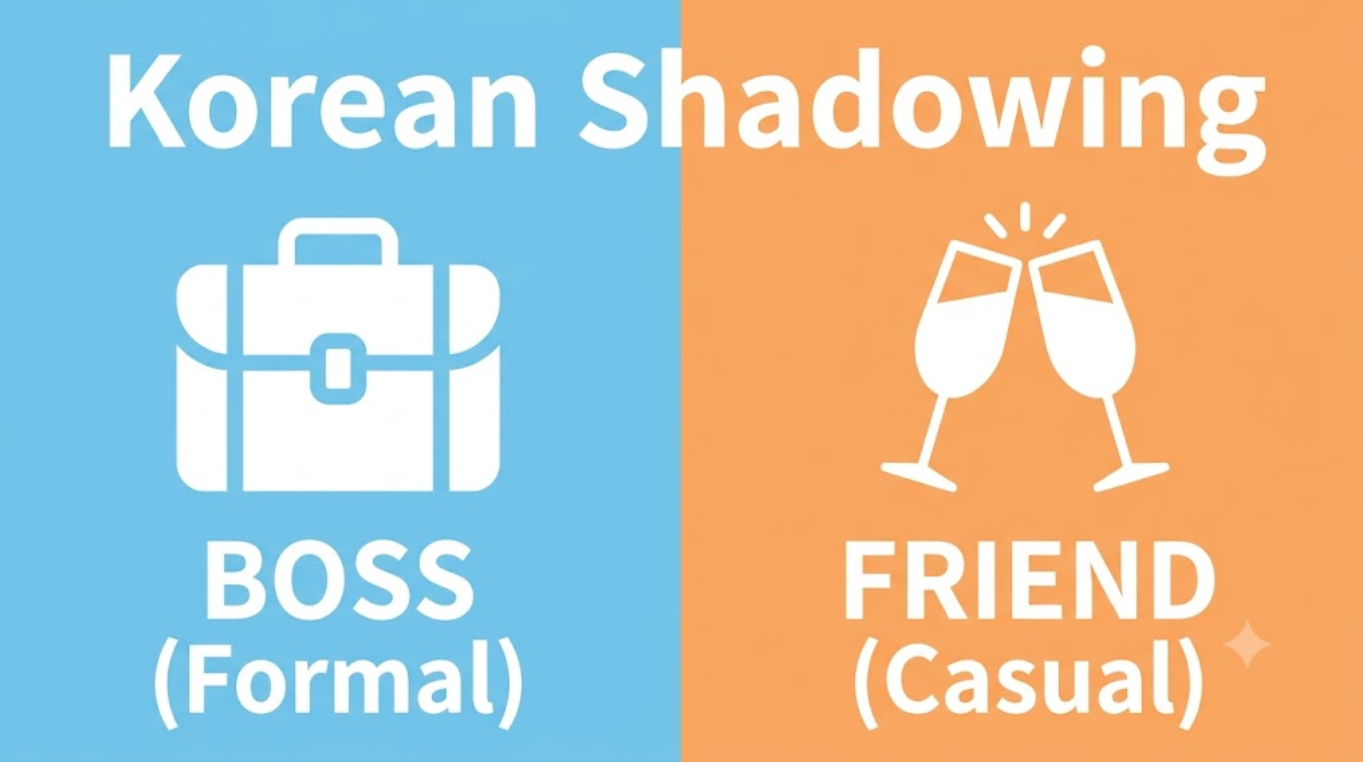
💬 Korean Shadowing Challenge: Formal vs Casual
Welcome to our 10-minute Korean Shadowing lesson! Changing speech levels is the key to becoming a true Korean speaker. Let’s practice these essential phrases together. Ready for a challenge?
How to Shadow This Page
아래 문장들, 그냥 눈으로 훑지 말고 이 순서로 연습해봐 — 훨씬 효과적이야.
Don’t just skim the sentences below — practice them in this order for much better results.
1. 듣기: 먼저 영상이나 문장을 소리 내지 않고 들어봐.
1. Listen: First, listen to the video or sentence without speaking.
2. 짧게 따라 말하기: 한 문장씩 끊어서 소리만 흉내 내봐.
2. Short Repeat: Mimic just the sound, one sentence at a time.
3. 대본 확인: 뜻을 확인하고, 존댓말과 반말의 차이를 비교해봐.
3. Check the Script: Check the meaning, and compare the formal and casual versions.
4. 속도 맞춰 따라 말하기: 이제 원래 속도에 맞춰서 자연스럽게 말해봐.
4. Match the Speed: Now say it naturally, matching the original pace.
8-Min Korean Shadowing : Formal vs Casual 1
Greetings & Small Talk
👥 상황: 오랜만에 만난 지인이나 동료끼리
Situation: Meeting an acquaintance or colleague after a while
It’s great to see you again.
존댓말: 다시 뵙게 되어 반갑습니다.
반말: 오랜만이다, 반가워.
It’s nice to see you again.
존댓말: 다시 만나서 반갑습니다.
반말: 다시 만나서 반가워.
How have you been?
존댓말: 잘 지내셨나요?
반말: 잘 지냈어?
It’s been a while!
존댓말: 오랜만이에요!
반말: 오랜만이야!
It was great talking with you.
존댓말: 이야기 나눠서 즐거웠습니다.
반말: 이야기 나눠서 즐거웠어.
Take care of yourself.
존댓말: 몸조심하세요.
반말: 몸 조심해.
Stay well and take care.
존댓말: 건강히 잘 지내세요.
반말: 잘 지내고, 몸 관리 잘해.
Morning Routine
👥 상황: 가까운 친구나 가족끼리 아침 얘기
Situation: Talking about mornings with close friends or family
Are you a morning person?
존댓말: 아침형 인간이신가요?
반말: 너는 아침형 인간이야?
I’m slow in the morning.
존댓말: 저는 아침에는 좀 늘어져요.
반말: 나는 아침에는 좀 늘어져.
Do you wake up early every day?
존댓말: 매일 일찍 일어나시나요?
반말: 매일 일찍 일어나?
Yes, I usually get up around 6 o’clock.
존댓말: 네, 보통 6시쯤 일어나요.
반말: 응, 보통 6시쯤.
Daily Life & Reactions
👥 상황: 친한 친구끼리 캐주얼한 잡담
Situation: Casual small talk between close friends
Did you forget anything today?
존댓말: 오늘 뭐 깜빡한 거 있으신가요?
반말: 오늘 뭐 깜빡한 거 있어?
Yes, I forgot my notebook.
존댓말: 네, 노트북을 깜빡했어요.
반말: 응, 노트북을 깜빡했어.
Do you forget things a lot?
존댓말: 자주 깜빡하시나요?
반말: 너 많이 깜빡하냐?
Sometimes when I’m in a hurry.
존댓말: 가끔 서두를 때 그래요.
반말: 가끔 서두르면 그래.
Language Tip: ‘느리다’ vs. ‘늘어지다’
많은 학습자가 ‘느리다’랑 ‘늘어지다’를 헷갈려 해. / 둘 다 속도나 에너지랑 관련 있지만, / 한국어에서는 서로 다른 느낌(뉘앙스)으로 쓰여.
Many learners get confused between ‘느리다’ and ‘늘어지다.’ / While both can relate to speed or energy, / they have different vibes in Korean.
1. 느리다 (Slow)
객관적인 속도를 말할 때 써. / 무언가가 물리적으로 빠르지 않으면 ‘느리다’라고 해.
Use this for objective speed. / If something is literally not fast, use ‘느리다.’
인터넷 / 기기:
- “이 동네는 인터넷이 너무 느려요.”
(The internet is too slow in this neighborhood.) - “핸드폰을 오래 썼더니 속도가 많이 느려졌어요.”
(My phone became much slower because I’ve used it for a long time.)
행동 / 반응:
- “저는 행동이 좀 느린 편이에요.”
(I tend to be a bit slow in my actions.) - “일처리가 느려서 죄송합니다.”
(I’m sorry for the slow work processing.)
이동 / 교통:
“주말이라 차가 너무 느리게 가네요.”
(Traffic is moving so slowly because it’s the weekend.)
2. 늘어지다 (Sluggish / Drawn-out)
게으르거나, 에너지가 없거나, ‘축 처진’ 상태를 묘사할 때 써. / 아침에 몸이 무겁고 에너지가 없을 때 쓰는 / 아주 자연스러운 원어민 표현이야.
Use this to describe a state of feeling lazy, low-energy, or “stretched out.” / It’s a very native way to describe having no energy in the morning.
신체 상태 / 에너지 (Sluggish, Tired):
- “비가 오니까 몸이 무겁고 늘어져요.”
(Because it’s raining, my body feels heavy and sluggish.) - “점심을 먹고 나니 몸이 졸리고 늘어지네요.”
(After having lunch, I feel sleepy and sluggish.)
휴식 / 게으름 (Lazing around):
- “주말에는 집에서 푹 늘어져서 쉬고 싶어요.”
(On weekends, I just want to stretch out and lounge at home.)
일정 / 상황 (Drawn-out, Dragging on):
“회의가 예상보다 너무 늘어졌어요.”
(The meeting dragged on much longer than expected.)
요약하자면, ‘느리다’는 속도에 관한 거고, / ‘늘어지다’는 기분이나 에너지 상태에 관한 거야!
In short, ‘느리다’ is about speed, / but ‘늘어지다’ is about your vibe or energy level!
다음에 아침에 조금 게으름을 피우고 싶을 때는 / ‘늘어지다’라는 표현을 꼭 써봐.
Try using ‘늘어지다’ next time you feel a bit lazy in the morning.
Language Tip: ‘깜빡하다’ (To Forget Momentarily)
잠시 동안 무언가를 잊어버리는 상태야.
To forget something temporarily.
보통 바쁘거나 다른 것에 정신이 팔려 / 순간적으로 기억이 나지 않는 상태를 뜻해.
It often implies a brief lapse in memory, / usually due to being busy or distracted.
가스레인지 켜놓고 온 것처럼 실수를 깨달았을 때, / 원어민처럼 들릴 수 있는 표현들이야!
When you realize you’ve made a mistake — like leaving the stove on — / use these phrases to sound like a native speaker!
Situational Expressions & Examples
완전히 깜빡했어. / 내 머릿속에서 완전히 빠져나갔어.
“I completely slipped my mind.”
방금 깜빡했어. / 머릿속에서 그냥 나갔어.
“It just went out of my head.”
순간적으로 깜빡했어. / 기억이 잠깐 끊겼어.
“I had a momentary lapse in memory.”
하얗게 머릿속이 하얘지며 깜빡했어. / 아무것도 기억이 안 나.
“I drew a blank.”
| Situation | 한국어 예문 | English |
|---|---|---|
| Appointments | 미안, 약속을 깜빡했어. | Sorry, our appointment completely slipped my mind. |
| Calls & Messages | 어제 전화했어야 했는데 깜빡했어. | I was supposed to call you yesterday — it slipped my mind. |
| Bringing Items | 보고서 가져오지 못했어, 깜빡했어. | Sorry I didn’t bring the report. It slipped my mind this morning. |
| Anniversaries | 오늘이 네 생일이었는데 깜빡했어. | It slipped my mind that today was your birthday. |
| Schedule Changes | 회의가 바뀐 걸 몰라서 깜빡했어. | I didn’t know the meeting was moved. It slipped my mind. |
“slip my mind” in Korean?
Native Nuance
‘깜빡하다’는 ‘잊어버리다’보다 / 덜 심각한 느낌이야.
‘깜빡하다’ is less serious than ‘잊어버리다.’
‘잊어버리다’는 정보를 완전히 상실했다는 느낌인 반면, / ‘깜빡하다’는 곧 다시 생각날 것 같다는 뉘앙스를 담고 있어.
‘잊어버리다’ implies losing the information entirely, / while ‘깜빡하다’ suggests it will likely come back to you soon.
Key Korean Expressions Summary
| 한국어 | 영어 뜻 (Meaning) |
|---|---|
| 느리다 | To be slow (objective speed) |
| 늘어지다 | To be sluggish / drawn-out |
| 깜빡하다 | To forget momentarily |
| 잊어버리다 | To forget entirely |
| 뉘앙스 | Nuance |
| 존댓말 | Formal/polite speech |
| 반말 | Casual speech |
| 서두르다 | To hurry |
Review Quiz: Formal vs Casual Shadowing Challenge
(Answers are at the bottom.)
Look at the English sentence and the speech level (formal/casual), / then write the Korean that belongs in the blank.
Part 1: Greetings & Small Talk
- It’s great to see you again. (존댓말) ( )
- It’s great to see you again. (반말) ( )
- How have you been? (존댓말) ( )
- It’s been a while! (반말) ( )
- Take care of yourself. (존댓말)
( )
Part 2: Morning Routine & Daily Life
- Are you a morning person? (반말)
( ) - I’m slow in the morning. (존댓말)
( ) - Yes, I usually get up around 6 o’clock. (반말)
( ) - Did you forget anything today? (존댓말)
( ) - Sometimes when I’m in a hurry. (반말)
( )
Part 3: Word Choice — 느리다 vs 늘어지다
Fill in the blank with either 느리다 or 늘어지다 (conjugated correctly).
- 인터넷이 ( ).
(The internet is slow.) - 아침에는 몸이 ( ).
(I feel sluggish in the morning.) - 이 노트북은 너무 ( ).
(This laptop is too slow.)
Part 4: Word Choice — 깜빡하다 vs 잊어버리다
Fill in the blank with either 깜빡하다 or 잊어버리다 (conjugated correctly), based on which fits the nuance.
- 미안, 약속을 ( ).
(I completely forgot about our appointment — it was a brief lapse, and I’m sure I’ll remember these things better next time.) - 어릴 때 배운 건 다 ( ).
(I’ve forgotten everything I learned as a kid — it’s gone for good, not coming back.)
Part 5: Complete the Situational Expression
- 어제 전화했어야 했는데 ( )
(I was supposed to call you yesterday — it slipped my mind.) - 오늘이 네 생일이었는데 ( ).
(It slipped my mind that today was your birthday.) - 회의가 바뀐 걸 몰라서 ( )
(I didn’t know the meeting was moved. It slipped my mind.)
🧩 Quick Practice Quiz
Test your knowledge before you go! Choose the correct Korean expression for each situation.
Q1. Speech Level Check (존댓말 vs. 반말)
You run into an older colleague or your manager at work after the weekend. How should you naturally ask “How have you been?” in Korean?
- A) 잘 지냈어?
- B) 잘 지내셨나요?
- C) 오랜만이다!
👉 Click to see the Answer & Explanation
- Answer: B) 잘 지내셨나요? (← Highlight or drag text to reveal!)
- Explanation: Option A and C are casual (반말) forms used with close friends or younger people. When speaking to a colleague, manager, or elder, use the polite honorific form “잘 지내셨나요?”
Q2. Vocabulary Vibe Check (‘느리다’ vs. ‘늘어지다’)
You woke up this morning feeling sluggish, lazy, and low on energy. How would a native Korean speaker describe this feeling?
- A) 아침에는 몸이 느려요.
- B) 아침에는 몸이 늘어져요.
- C) 아침에는 몸이 깜빡해요.
👉 Click to see the Answer & Explanation
- Answer: B) 아침에는 몸이 늘어져요. (← Highlight or drag text to reveal!)
- Explanation: While ‘느리다’ means literally/objectively slow in speed (e.g., slow internet), ‘늘어지다’ expresses feeling stretched out, lazy, or sluggish in energy!
Q3. Real-life Nuance Check (‘깜빡하다’)
Which of the following situations is the most natural time to say “깜빡했다!”?
- A) When you permanently forget an entire language you learned years ago.
- B) When you intentionally decide not to do your homework.
- C) When you momentarily forgot your umbrella at home because you were in a hurry.
👉 Click to see the Answer & Explanation
- Answer: C) When you momentarily forgot your umbrella at home… (← Highlight or drag text to reveal!)
- Explanation: ‘깜빡하다’ is specifically used for temporary lapses in memory—like briefly slipping your mind when distracted or rushed!
Answer Key
Part 1
- 다시 뵙게 되어 반갑습니다.
- 오랜만이다, 반가워.
- 잘 지내셨나요?
- 오랜만이야!
- 몸조심하세요.
Part 2
6. 너는 아침형 인간이야?
7. 저는 아침에는 좀 늘어져요.
8. 응, 보통 6시쯤.
9. 오늘 뭐 깜빡한 거 있으신가요?
10. 가끔 서두르면 그래.
Part 3
11. 느려요 (objective speed)
12. 늘어져요 (low-energy state)
13. 느려요 (objective speed)
Part 4
14. 깜빡했어 (a light, soon-to-be-remembered slip)
15. 잊어버렸어 (a completely lost memory)
Part 5
16. 깜빡했어
17. 깜빡했어
18. 깜빡했어
Related Lessons
👉 Korea Travel Guide: Maengbang Beach in Gangwon-do
👉 8-Minute Korean Shadowing: Compliments & Gratitude
👉 More Casual Korean Lessons